
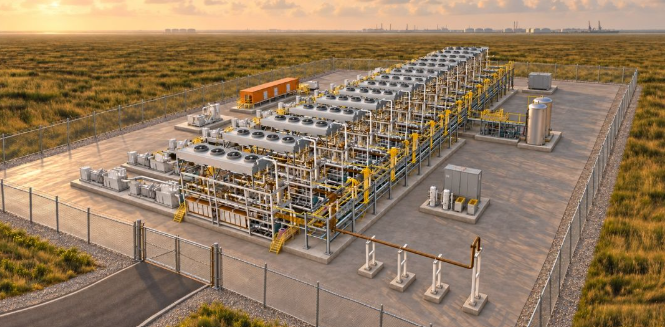
Plug Power has launched GenEco Scale, a new integrated electrolyser plant for utility-scale hydrogen production. Its first customer is Arcadia eFuels for its 280MW hydrogen plant at Project ARC, TX, US.
GenEco Scale works as standardised 20MW building blocks that enable repeatable plant configurations for projects around 100MW and above. It also arranges process skids and cooling equipment vertically across multiple levels, offering a reduction in land, infrastructure and capital requirements.
Plug Power has completed the technical evaluation and front-end engineering design (FEED) study for Project ARC. It is designed to produce around 23.2 million gallons of electro-sustainable aviation fuel (e-SAF) a year, with the renewable hydrogen will be used as a foundational feedstock. Plug Power and Arcadia eFuels are already in partnership through Project ENDOR in Denmark.
José Luis Crespo, President and Chief Executive Officer of Plug Power, commented: “Our customers aren’t just looking for more electrolyser capacity; they’re looking for ways to build large-scale hydrogen projects at a lower cost. By reducing the physical footprint and infrastructure required, we’re helping developers lower capital expenditures and improve overall project economics. GenEco Scale is purpose-built for projects like Arcadia eFuels’ 280 MW Project ARC, where efficiency and cost optimisation are critical at this scale.”
Amy Hebert, Chief Executive Officer of Arcadia eFuels, said: “When developing a project of this scale, it's not just about selecting the right technology: it’s about having a clear, cost-effective path from engineering through construction. Reducing the engineering burden on our engineering, procurement and construction partners and minimising the complexity of bringing these systems together were important considerations for Project ARC. We see GenEco Scale as an approach that can help us move forward with greater efficiency and confidence, building on our established partnership with Plug. Together, we’re taking another step toward producing the world’s future fuels to protect our environment and power our world.”