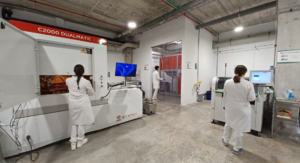



The Catalonia Institute for Energy Research (IREC) has launched a new pilot line for the manufacturing of ceramic devices using 3D printing for the generation and use of renewable hydrogen. This manufacturing process for complete modules is disruptive and unprecedented worldwide. This achievement positions IREC as a global pioneer in the field and represents a strategic advance for hydrogen technology manufacturing in Catalonia.
This pilot line, presented under the name Merce Lab (Manufacturing Energy Ceramic Devices), has been installed thanks to funding from the company H2B2 within the framework of the Tecnopropia project (IPCEI programme), among other initiatives. It will manufacture solid oxide cells (SOC) for fuel cells and electrolysers at pre-industrial scale.
Currently, very few actors worldwide are capable of manufacturing this type of cells, which stands out for its high efficiency, superior to competing technologies. Thanks to 3D printing of functional ceramics, Merce Lab has become the first laboratory in the world to use this method to produce SOC cells.
The main advantage of 3D printing is its flexibility in design, reduced material consumption, and a drastic reduction in the weight and volume of the final device, thus increasing the energy density of the final systems. This increase in energy density makes these devices particularly attractive both for transport applications and for storing renewable energy through hydrogen generation.
This is a highly innovative and scalable technology, structured into various blocks ranging from the preparation of basic components to cell stacking and validation. This structure will promote technology transfer to companies both nationally and internationally, and will support the creation of new business models aimed at accelerating the industrialisation of renewable hydrogen.
Marc Torrell, head of Merce Lab at IREC, says: 'This facility positions us as pioneers in SOC manufacturing at a global scale. This is a disruptive approach to manufacturing processes and performance of ceramic-based devices, opening the door to new SOC systems for applications that previously could not meet desired requirements, such as maritime or aviation transport.'
This initiative is part of an Important Project of Common European Interest (IPCEI) on hydrogen, called Tecnopropia (~€25M), led and co-funded by the electrolyser company H2B2 with Next Generation funds from the Spanish Recovery, Transformation and Resilience Plan (PRTR). The laboratory is also financed by other ongoing international-scope projects at IREC, such as CLEANHYPRO, HYP3D, COMECOCO2 and H2SHIFT. The initial investment for this pilot line is 2 million euros.
IREC has already fabricated the first complete devices in this laboratory, and is forging strategic collaborations with industry partners, including major corporations (H2B2, 3Dceram, AMES, Viver Clean Tech) and smaller companies (AESA, Nano4Energy, M-reformer), with the goal of accelerating the development and commercialisation of this technology. This initiative will not only facilitate the entry of hydrogen into the Spanish market but will also help democratise access to cleaner and more sustainable energy technologies.
The development of this pilot line responds to the growing volume of investment being allocated to infrastructure for deploying the hydrogen economy. In this context, IREC plans to create Oxhyd Energy, a spin-off dedicated to the commercialisation of SOC fuel cells as a key element in the energy transition.
IREC Launches Pilot Plant For Hydrogen Technology Manufacturing